Hydranet Monthly Recap #48 — July 2026
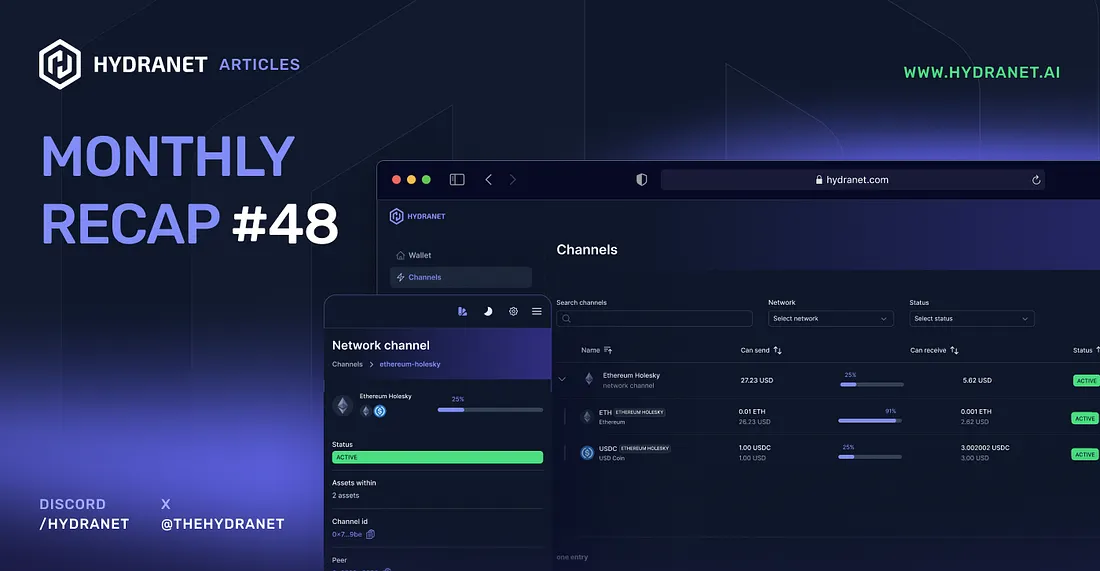
July has been another month of developing and testing as we continue working toward mainnet. Issues uncovered during testing have led to a wide range of improvements across the application, alongside an updated Lithium audit!
Testing has also resumed on the updated DEX interface, which brings DEX and CEX-style trading together in a cleaner and more intuitive experience. Feedback from our testers continues to play an important role in refining the interface and the platform as a whole.
Lithium audit — updated
The Lithium audit received another update on July 18 after we made a small but useful improvement to the contract.
The goal was to reduce our dependency on the indexer when keeping track of what is happening on-chain. Therefore, we added events to the Lithium contract that make it easier for our infrastructure to follow important changes, such as channels being opened or closed.
While this may sound like a small technical detail, it has a direct impact on reliability and the user experience. The more information we can get directly from the blockchain, the less we have to rely on additional services to piece together what is happening.
The update was deliberately kept as small as possible. The core contract logic was not changed, and there were no changes to how Lithium handles its functions or performs its off-chain state updates.
Cyberscope kindly updated the audit to cover this new version of the contract. The July 18 iteration reports 0 findings across the critical and medium severity levels.
So, while this was not a new audit prompted by a security issue, we wanted the audited version to accurately reflect the contract we are actually building and deploying.
The devil is in the details
Some of the most noticeable improvements this month have been in the smaller details. Token icons, trading pair presentation, and amount inputs have all received UI refinements. Cache handling has also been improved, contributing to better overall application stability and experience.
We have also improved wallet synchronization and the reliability of transaction histories, as well as transfers between Public and Protected balances. Work on the backend has continued in parallel, with further improvements targeting synchronization and overall platform reliability.
We’ve also addressed issues on the spot page, improving order-book updates and price synchronization. The Lightning channel creation and channel rental workflows have also received attention.
These are the kinds of things that may sound small on their own, but they become important when the goal is for the trading experience to feel consistent and predictable.
Our testers have also shared valuable feedback on transaction-history exports, fee visibility, terminology, and other usability details. These areas will continue to be refined as development progresses.
Testing of the redesigned interface is already underway, while the latest fixes and improvements are being bundled into the next platform release for our testers.
Preparing the ground for mainnet
Alongside development, we have continued working on the primary remaining step before mainnet testing can begin: securing sufficient channel-lease liquidity.
This requires a trust-based arrangement with larger investors, as the DAO’s Titan keys remain under DAO control rather than the investors’ control. We are actively working toward a solution that provides a strong foundation for launch rather than rushing the process.
This work is progressing in parallel with UI testing, backend improvements, and several other development workstreams. We will share further information about upcoming milestones and planned events as soon as the timeline becomes sufficiently predictable.
A big thank you to everyone who has been actively testing and reporting issues. Your feedback is directly contributing to the product we’re building, and every report helps us get one step closer to a stable and polished mainnet release!