Hydranet Monthly Recap #42 — January 2026
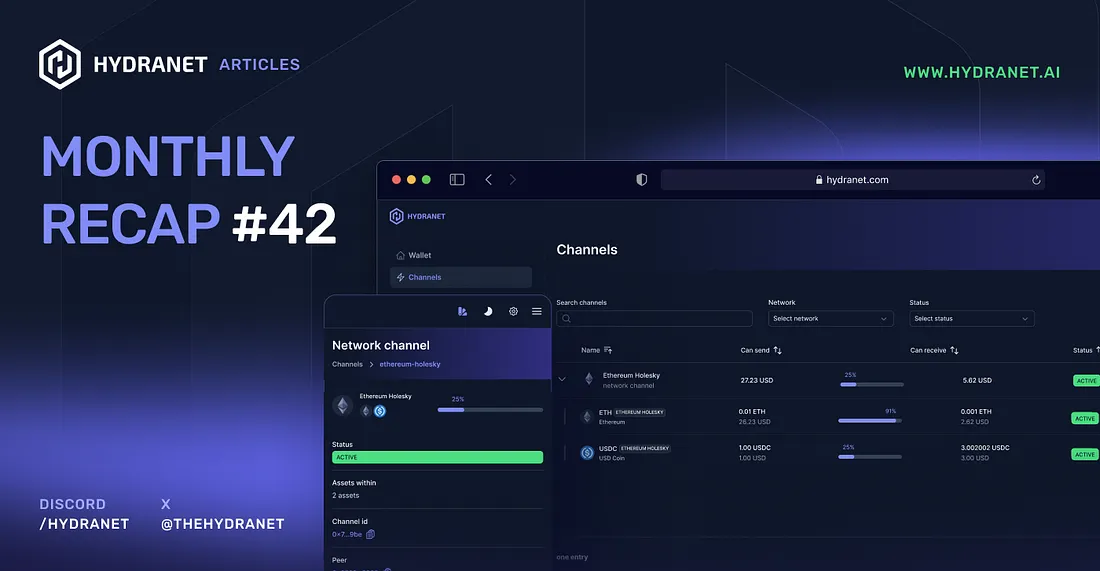
The first recap of the year is here and 2026 starts with one clear objective: mainnet. January has been quieter in terms of public releases, but, as always, very active behind the scenes. Rather than pushing frequent builds and repeatedly rolling them back to address bugs, we’ve chosen a more controlled and deliberate approach. Extensive automated testing and validation before anything reaches the community. This ultimately leaves us with fewer releases, but stronger ones, with a focus on stability and quality first.
Thank you for your patience while we build this the right way.
Lithium audit
A major focus in January has been the audit of Lithium. Over the years, Lithium has evolved from a relatively small on-chain contract with supporting off-chain logic into a full-fledged core component of the Hydranet infrastructure. Through continuous improvements, optimizations, and bug fixes, it has matured into a system capable of handling significantly more complex transaction flows, edge cases, and security functions reliably.
With this maturity, we decided it was time for a professional audit. An audit isn’t about proving the code is perfect, it’s about finding what needs improvement before mainnet. Discovering issues now is far better than discovering them later.
The audit is conducted in two stages. In the first stage, the auditors perform a thorough review of the codebase, analyzing execution paths, evaluating potential attack vectors, and examining the overall logic and security of the system. The findings are then summarized in a report shared with us.
In the second stage, we address the reported issues and submit the updated version for a re-audit, where the auditors verify that all fixes have been properly implemented.
The first iteration has now been completed and the report delivered. As expected, issues were identified. That’s exactly what we want. Finding weaknesses early is a positive outcome, not a setback. We have already begun addressing the findings which have resulted in some minor updates to the Lithium on-chain contract. In several cases however, the off-chain logic already mitigates the found risk entirely. This will be clarified with the auditor as we aim to submit the updated version for re-audit as soon as possible.
DAO vote
In accordance with our statutes, the yearly renewal of multi-sig members took place in January and most members remain unchanged.
Ipally is stepping down after many years of valuable contributions across financial and operational foundations. We’re grateful for the work he has put into Hydranet. He remains part of the community and is always reachable if support is needed.
As a replacement, Joe Park joins the multi-sig. Joe has been a long-time contributor to Hydranet, deeply involved in both team building and maintaining efficient operation across the team's activities. We’re happy to welcome him into this role.
Yearly recap
Continuing our yearly tradition, we also published the Hydranet 2025 recap in January, summarizing everything accomplished over the last year.
It’s easy to lose sight of progress when working day by day, but looking back really puts things into perspective. Over the course of the year, Hydranet moved from Closed Alpha to Open Beta, attended several live spaces, completed a token swap, and made significant progress on the Hydranet DEX and Lithium.
If you haven’t already, make sure to give it a read here.
Hydranet, welcome to 2026!